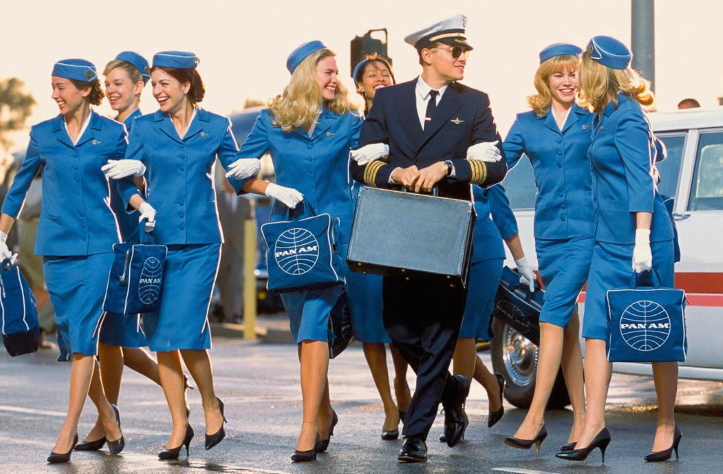
“Sometimes it’s easier to live the lie.”

Justin’s rating: Too bad he didn’t pretend to be a cruise ship captain, cause, you know, that would’ve helped out in an earlier film
Justin’s review: There’s a one-screen theater in the small town near where I live. Although it’s been open since 1941, the Penn Theatre faced antiquity at the hands of the local googleplexes. But fortunately, some new management invested in a renovation and a decision to show first-run flicks, thus enabling me the pleasure of catching Catch Me If You Can with a small bag of real buttered popcorn in hand. It’s nothing fancy, for a theater: it lacks the large stadium seating of the AMC 20 up the road, and the seats rose to about my mid-back and quit. Yet still I enjoyed it tremendously, partially due to the fact that everything in the theater felt real and not artificial, and also because there were a total sum of NO commercials and TWO previews before the show. Ahh.
With a retro ’60s style of cool, Catch Me If You Can could be loosely compared with the recent Ocean’s 11 in its general mood. Both had con men who had enough suave and daring-do to make us like them despite their crimes, and both brought a lost sense of smooth filmmanship back to the screen. But while Ocean’s 11 was out to give us a good time and nothing else, Catch Me gives us a good time to cover up what a horrible time the characters are having.
Frank Abagnale (Leonardo DiCaprio) is a 17 year old who has such an odd name that I kept thinking to myself “Abigale?” “Abnagale?” “Abgnile?” It’s so distracting to have those voices in your head that don’t shut up when they’re supposed to. Frank’s life comes to a crashing halt when his mother moves out and his father comes under investigation from the IRS. Normally, a boy like Frank would deal with his woes by constructing a black-on-black shaded website as a depository for angsty poems like “The Dead In My Driveway” and “Lyfe Sux, Then You Misspell Every Other Word.”
Frank, however, takes a different track, and starts lying.
He steps into professions that seem absurd for a teen, from a high school substitute teacher all the way to being a doctor, but he manages to pull it off for two reasons. One, he’s a smart little rascal, and two, he realizes that if you act like you’re where you’re supposed to be, doing what you’re supposed to be doing, then nobody will question you. His “pretending” is a not-too-subtle parody of what real actors do every day, except that Frank’s acting takes place in the real world and has real consequences.
On top of making his career life grander than grubbing for good grades, Frank engages in a steadily inclining line of check forgery. This draws the attention of Carl Hanratty (Tom Hanks), a sort of Elite Nerd Accountant in the FBI. Thus, a game of cat and mouse ensues, as Hanratty chases Abagnale across the country and globe. Seriously, folks, names this weird can ONLY come through real life tales. Hanratty?
It’s all really sort of fun, a lot more enjoyable to sit back and let wash over me than I thought it would be. Frank’s a kid, but we’ve been trained to admire gutsiness, and what’s a few million dollars stolen between friends? Carl also seems to really enjoy getting to exercise his license to kill (or exercise, period), tracking Frank down with all the glee of a geekier Sherlock Holmes.
Unfortunately, the fun is a charade, covering up broken lives, where the glamor of fakery is ultimately pointless. Frank sees his future in his dad (Christopher Walken in one of his best non-threatening roles), yet can’t seem to avoid going down that same road. He’s constantly on the move, abandoning former lives in order to escape from the law, and doesn’t have a chance to be a part of the one thing he wants the most: a family.
[Sidetrack note: If Chris Walken is looking for a job, wouldn’t it be SO COOL to hire him as your personal secretary? Telemarketers would be so creeped out just trying to call you that they’d stop bothering you! Soliciters would take one look into his steely eyes and humbly offer to commit suicide right there! IRS auditors would freely give you money just to take your goon and get out of the building! Plus, the office parties would just rock; I’m sure Walken is just the type who photocopies his buttocks when he’s had a few too many drinks.]
Likewise, Carl’s life as a die-hard researcher, working at the office even on Christmas Eve, is something to be feared and pitied. I got the feeling that Carl didn’t have much to live for outside of work, and work itself is a sterile line of desks and paper files. I did really appreciate that the filmmakers didn’t play Carl like the typical movie cop, drawn into an elaborate scheme due to his curiosity. When Frank calls up to goad Carl, Carl tells him straight out he’s going to jail, that it isn’t a game, it isn’t innocent. Good for him.
Just a lot of little things made this a delightful flick, including quite a bit of underplayed humor, one of John William’s best scores of the last decade, and a slight uncertainty that rippled over the crowd as we tried to figure out whether we were supposed to be envying or pitying the characters. Catch Me If You Can might not be standard Mutant fare, but it’s most definitely accessible.

DnaError’s rating: Swank digs, daddy-o
DnaError’s review: If there was any trend in 2001-02, it was entertainment directors trying to “prove” themselves. After Soderberg’s look-Ma-I’m-an-art-director Solaris, to Mednes’s so-boring-it-has-to-be-important Road to Perdition, anyone could use a break. And what a break it is.
Catch Me If You Can is a finger-snapping, hip-shaking, bingo-bango good time. Spielberg (who also “proved” himself with not one but TWO huge-important-movies last year) lets the retro swankiness take off, making everything so light and funny it just may take off and fly away.
The title sequence of the movie is a work of genius. Without giving anything away, it animates and replicates the late ’50s-early ’60s look, right down to the typefaces. I have a not-so-fleeting nostalgia for this time period. Typical problems with nostalgia aside (selective memory for one), the late ’50s Bond-Era Swank is too hip, too cool, too impossibly refined and relaxed to ignored. It’s the opposite of all the dirty, unfocused, muddy hippie crap that would come later. No where is this seen more then in the music…The late 50s lounge style was the continuation of a cultural trend that had begun centuries before, preferring complex simplicity and professional arrangements to brash explosions and adolescent wailing. Music by adults for adults, not neo-romantic Byrons who couldn’t play more than three chords to save their lives.
Mind you, I like the rock and weirdness that came after, but I think that by throwing everything connected to sophistication in the ’60s away, we lost a sense of professionalism and composure. In short, we lost our cool.
Didja notice?
- Sydney from Alias is doing undercover work in the 60s!
- The blackboard that Carl Hanratty is writing on toward the end of the movie contains a small note at the bottom that says, “Steven and Tom’s 4th project”. Steven Spielberg and Tom Hanks, had previously collaborated on Band of Brothers, Saving Private Ryan and Joe Versus the Volcano.
- The fluttering dollar bill is a reference to the floating feather from Forrest Gump
- The episode of “To Tell the Truth” shown at the beginning was an actual episode of the show involving Frank Abagnale, Jr. with Leonardo DiCaprio Forrest Gumped into it for verisimilitude.
- The clips we see from Goldfinger, though seen only seconds apart, are actually around an hour apart.
- During one of the Christmas telephone conversations between Frank and Carl, Frank’s phone has a modular telephone jack connection. Modular telephone jacks did not exist at the time.
- The US currency seen throughout the movie is from the 1996 and 1999 issues (with the larger presidents).
- When Hanratty is looking at a map of Europe trying to figure out where Abagnale is, Germany is unified in the map
 Mutant Reviewers