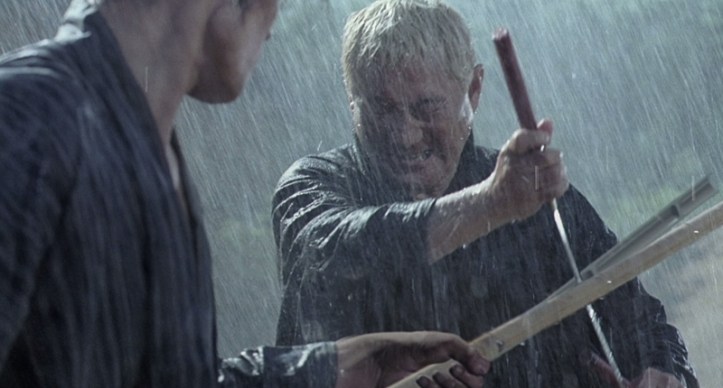
“Even with my eyes wide open, I can’t see a thing!”

Shalen’s Rating: Two out of two reasons why “paper as building material” and “really sharp swords as weapons” do not mix well.
Shalen’s Review: What a great movie. And for once, I’m not actually being sarcastic when I say that. This was my second viewing of The Blind Swordsman: Zatoichi, and I have to say it was just as good the second time. Although, before I continue, I should admit that I have no background either in Zatoichi novels and films (of which there are many) or Takeshi Kitano (Beat Takeshi) films, of which there are also a large number. Certainly, after this I know I have to see Battle Royale. If it has anything like Zatoichi’s style it’s got to be a must-see.
Not that the two films are very similar otherwise. Zatoichi is a historical fiction, set in a period when everyone wore kimono or kilt-like garments and that really uncomfortable-looking wooden footgear. The protagonist is a blind masseur who travels from town to town with his red “cane,” on which other people inexplicably can’t see the obvious seam between sword hilt and sheath. In this particular case, he’s gently tapped his way into a small town which has two or three (I’m still not quite sure) rival gangs competing for gambling and extortion rights. In the process of solving the town’s problems, Zatoichi helps out a silly local gambler, the sly old woman who lets him stay in her house, and a pair of geishas who want to avenge the deaths of their family. Fortunately for him, all of these things can be accomplished merely by slaughtering people with a sword.*
His only real obstacle is the traveling ronin Hattori Genosuke, now working as a “bodyguard” for one of the gangs. Hattori is a stone-cold killer, of course, but we’re given to understand it’s only so that he can support his sick wife. The manner lent him by actor Tadanobu Asano supports this idea — he never acts as if he really enjoys what he’s doing. He doesn’t strut. He walks like a man who’s just been beaten with a stick, which I found to be one of the film’s better touches.** He also gets more character development than any of the gangster bosses do.
This film has something for just about everyone. It has beautiful, stylishly gory sword fights (no cop-out black blood here, folks, and I do not recommend cherry slushies while watching). The choreography is good and the cutting is not annoying. It has lovely women in attractive period clothing. It has men in those sexy samurai-style hairdos. Hmmm. Maybe those are not quite so sexy, but they are yards beyond the samurai equivalent of shorts, which appears to be a highly abbreviated robe over white spandex.*** Where was I? I was frozen in horror for a second there. The film has a wonderful soundtrack. And it ends in a huge group tap dance.**** The use of color is also wonderful, and not just in the moments when red blood is contrasted with a wide variety of environments.
A lot of the film’s better action and drama moments have no dialogue, so the quotes section doesn’t really do it justice. Part of that is because the film is in Japanese. Part of it is because the dialogue generally has to do with the least interesting parts of the plot, such as the stereotypical gangster squabbles and the attempts at comic relief. The latter may not actually be lame, but they come across that way when translated for Westerners. For that matter, I can see why this movie hasn’t been popular in the U.S. — the protagonist is an older guy, there is no love interest and no sex scenes, and it ends in dancing instead of a lone Caucasian in a trench coat striding off into an urban sunset. In fact, this film is almost exactly the antithesis of the Underworld franchise. Which I liked. But I like this better. I’ll bet you will, too, even without Kate Beckinsale in black PVC.
Wow. What a weird note to end on.
*Why doesn’t it ever work out that way for me?
**I’m beginning to be quite a fan of Tadanobu Asano. I thought he played The Man (the ostensible villain) in Versus, but IMDB says that was Hideo Sakaki.
***And that is far better than what the gang-affiliated guys running the dice game wear, which appears to be those same undershorts continued upward to right under the pectorals with nothing over them. Japan long ago progressed beyond the United States in having men wear humiliating outfits as well as women, which is ironic considering the generally patronizing Western attitude in this area.
****Seriously. Though Zatoichi isn’t there. He’s busy doing his lone-hero-sneaks-out-of-town thing.
 Mutant Reviewers